
SDRs vs. Direct Introductions: Which Is Better For Your B2B Pipeline?
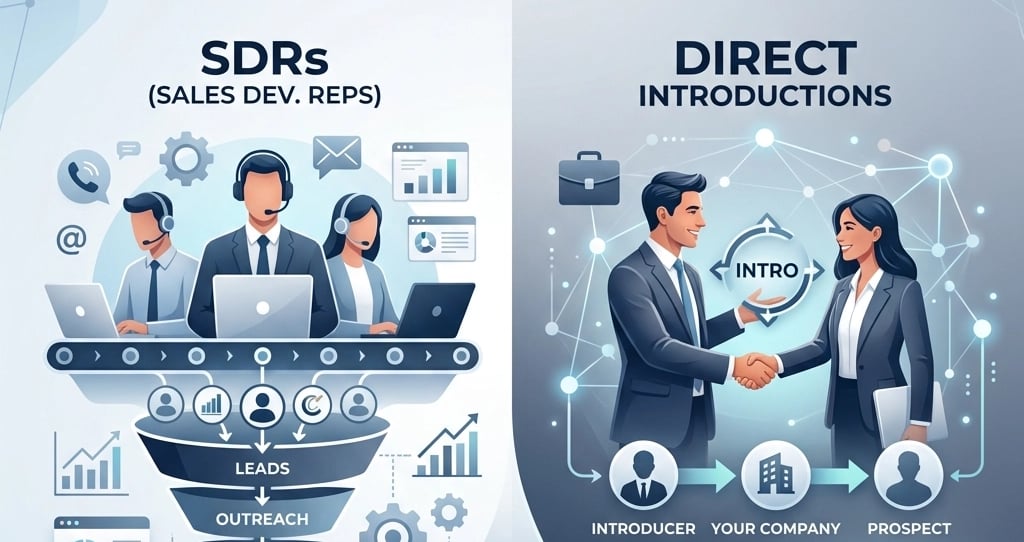
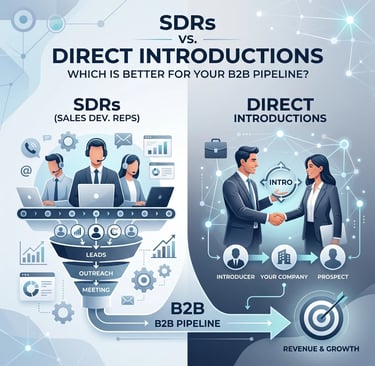
I’ve witnessed firsthand the frustration of watching a founder or a CEO stare at a spreadsheet of 5,000 "cold leads" that haven’t replied to a single email in three weeks. It’s a scene that plays out in almost every B2B boardroom. We often think of the Sales Development Representative (SDR) model as the gold standard for growth, the machine that grinds out meetings so your closers can close.
But lately, that machine feels like it’s missing a few gears.
When the outbound SDR model first launched, like many professionals, I thought it was the ultimate solution to the "empty calendar" problem. You hire a smart, hungry person, give them a tech stack and a script, and watch the pipeline grow. It worked beautifully for a decade. But today? The average response rate for B2B outbound is hovering somewhere between 1% and 3%.
If you’re running a service-based business, maybe you’re a staffing agency, a Private Equity firm looking for deal flow, or a fractional executive seeking your next client, the "spray and pray" approach isn't just inefficient. It’s actually damaging your reputation.
So, the question remains: Should you double down on the SDR model, or is it time to pivot toward direct introductions? Let’s dive into the reality of the B2B pipeline in 2026.
The SDR Model: Why It’s Stalling
The traditional SDR model is built on volume. It’s a math equation: if you send 100 emails, you might get 2 replies, which might lead to 1 meeting. To get 10 meetings, you just need to send 1,000 emails. Simple, right?
But here’s the catch: your prospects are exhausted. Their inboxes are overflowing with "personalized" messages that feel like they were written by a robot (and usually, they were). We’ve reached a point of diminishing returns where the noise is so loud that the signal is getting lost.
For high-ticket professional services, this is a death sentence. When you are selling expertise, trust is your primary currency. Cold outreach, by its very nature, starts with zero trust. You are a stranger knocking on a digital door, asking for time.


The Rise of the Direct Introduction
Compare that to a direct introduction. This is when someone your prospect already knows and trusts says, "Hey, you should talk to Jerry. He helped us solve [Problem X], and I think he can help you too."
In my experience, the conversion rate on a warm introduction isn't 1% or 3%. It’s often north of 50%. Why? Because the trust has been transferred. You aren't a stranger; you are a recommended solution.
For businesses where the "product" is a person or a complex service: like a PE firm searching for its next acquisition: trust isn't just a nice-to-have. It’s the entire game. In fact, many Private Equity firms are finding that deal flow isn't a lead problem, it's an introduction problem.
Breaking Down the "Trust Tax"
Every time an SDR reaches out cold, they pay a "Trust Tax." They have to spend the first two or three interactions just proving they aren't a scammer or a waste of time. They have to overcome the "why are you talking to me?" hurdle.
Direct introductions bypass the Trust Tax entirely. When a mutual connection bridges the gap, you start the conversation at the 50-yard line instead of the end zone.
Let's look at a concrete example. Take Sarah, who runs a boutique staffing agency specializing in tech talent. She has two options:
Hire an SDR for $60k/year (plus commissions and software) to cold-call CTOs.
Build a system that facilitates direct introductions from her existing network of VCs and founders.
If Sarah goes the SDR route, she might book 10 meetings a month, but 8 of them will be with people who are just "window shopping." If she goes the introduction route, she might only get 4 meetings, but 3 of them will likely turn into contracts because the trust was already there.
Efficiency vs. Effectiveness
We often confuse efficiency (doing things fast) with effectiveness (doing the right things). The SDR model is efficient at scale. You can blast thousands of people with a click. But for professional services, it’s rarely effective.
At IntroFlows, we talk a lot about how referrals don’t scale, but introductions do. Most people wait for referrals to happen by accident. They hope a client mentions them at a dinner party. That’s not a strategy; that’s a prayer.
A direct introduction strategy, however, is a proactive system. It’s about mapping your network, identifying the bridges to your ideal clients, and making it easy for people to connect you. It’s about building access, not just an audience.


Why Service-Based Companies are Pivoting
If you’re selling a $50/month software, an SDR model might still work. You just need volume. But if your average contract value is $50,000 or $500,000, you can't afford to be seen as a "spammer."
Staffing agencies, for instance, are notoriously aggressive with outbound. It’s why most HR directors have filters specifically to block them. This is why many staffing agencies are ditching intent data in favor of direct introductions. They’ve realized that knowing a company is "hiring" (intent) doesn't matter if you can't get the hiring manager to open your email.
The same applies to fractional executives. If you are a fractional CFO, your value lies in your wisdom and reputation. A cold LinkedIn message saying "I can help with your books" actually lowers your perceived value. A warm intro from a board member, however, positions you as an elite consultant.
The "Quiet Pipeline" Advantage
There’s a competitive advantage to moving away from the loud, crowded world of SDR outbound. I call it the Quiet Pipeline System.
While your competitors are shouting into the void, you are having private, high-level conversations. While they are fighting for attention in a crowded inbox, you are sitting in a scheduled Zoom call that was set up by a mutual friend.
This isn't just about being "classy." It’s about economics. The cost per acquisition (CPA) for a warm introduction is significantly lower than the cost of maintaining an SDR team, paying for LinkedIn Sales Navigator, ZoomInfo, and email sequencing tools.
So, is the SDR Dead?
Not exactly. But the role is changing.
The most successful companies today aren't using SDRs to "spray and pray." They are using them as "Introduction Specialists." Instead of asking an SDR to find 100 new leads, they ask them to find 10 people in the company’s existing ecosystem who can provide a bridge to a high-value target.
This is the AI-Human Intro GTM model. You use technology to find the paths of least resistance (the connections) and use humans to facilitate the actual introduction. It’s about using data to find who knows who, rather than just who is hiring.


How to Start Making the Shift
If you’re tired of the SDR treadmill and want to start building a pipeline based on access, here is how you can start:
Stop Building Funnels, Start Building Access: A funnel is a numbers game where most people fall out the bottom. Access is a "who you know" game where the right person brings you in. Read more on why you should stop building funnels.
Audit Your Network: Look at your last five closed deals. How did they actually start? I bet at least three of them came from some form of a warm introduction or a previous relationship.
Equip Your Allies: People want to help you, but they are busy. If you want a direct introduction, you have to make it "copy-paste easy" for them. Give them the blurb, give them the context, and give them a reason why the intro helps the other person, not just you.
Value Signals Over Intent: "Intent data" tells you a company is looking for a solution. A "signal" tells you why you are the right person to provide it. Learn the difference between intent and signals.
The Path Forward
The B2B landscape is shifting toward what I call the Access Economy. In a world where AI can generate 1,000 cold emails in three seconds, the value of a cold email has dropped to zero.
But the value of a trusted introduction? That’s at an all-time high.
Whether you are a PE firm looking for an off-market deal or a consultant looking for your next big project, the "who" will always beat the "how many." It’s time to stop worrying about how many leads are in your "top of funnel" and start worrying about how many doors are actually being opened for you.
Looking forward, the companies that win won't be the ones with the biggest SDR teams. They'll be the ones with the most robust networks and the systems to navigate them. It’s time to unleash the power of the warm intro.