
Referrals Don’t Scale. Introductions Do.

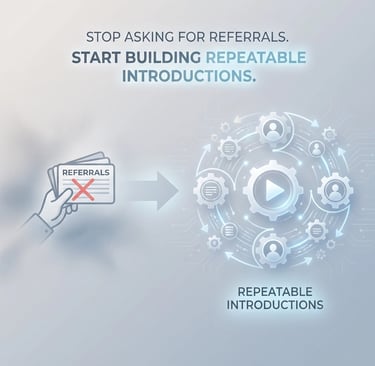
I've watched too many PE professionals damage relationships by asking for referrals at exactly the wrong moment. You know the scenario: pipeline's thin, quarter's ending, and suddenly everyone in your network gets the "quick favor" text.
The problem isn't that people don't want to help you. It's that asking for referrals treats your relationships like ATMs : useful when you need cash, ignored when you don't.
There's a better way. Instead of asking for referrals, build a system that generates introductions. The difference isn't semantic. It's strategic.
Referrals vs Introductions: Why the Distinction Matters
A referral is transactional. Someone ready, willing, and able to buy. It's a warm handoff to a decision-maker who's already in buying mode.
An introduction is relational. It's access to someone worth knowing, whether they're actively buying or not. The goal isn't immediate conversion : it's building a relationship that creates future opportunities.
For PE professionals, this distinction is crucial. Your best deals rarely come from companies actively shopping for capital. They come from relationships built months or years before a process starts. The CEO you met at an industry event. The operator who knows your portfolio company's space. The vendor who works with targets you care about.
When you ask for referrals, you're optimizing for this quarter. When you build introduction systems, you're optimizing for the next three years.


The PE Professional's Introduction Framework
Here's a lightweight system that generates consistent introductions without the awkward asks:
1. Build Your Target Lists (Not Just Companies)
Most PE professionals track companies. Smart ones track people. Your target lists should include:
Decision-makers at target companies (CEOs, founders, division heads)
Industry operators (former executives, consultants, advisors)
Service providers (bankers, lawyers, consultants who work your sectors)
Portfolio network (executives across your portfolio companies)
The key: these aren't prospect lists. They're relationship maps. You're not trying to sell these people : you're trying to know them.
2. Identify Your Trigger Events
Instead of quarterly referral requests, track events that naturally create introduction opportunities:
Portfolio company milestones (new hires, product launches, expansion)
Industry developments (regulation changes, market shifts, technology trends)
Personal updates (job changes, speaking engagements, board appointments)
Deal activity (transactions, partnerships, fundraising in your sectors)
When these triggers hit, you have natural reasons to reach out and reconnect. No forced asks required.
3. Master the Introduction Message
The best introduction requests don't feel like requests. They feel like value creation. Instead of "Do you know anyone who might be interested in selling?" try:
"Hey [Name], saw the piece about consolidation in your space. It made me think of a conversation I had with [Portfolio CEO] about similar challenges. Worth a quick introduction? I think you'd both find the perspectives interesting."
You're not asking for a favor. You're offering to connect two people who might benefit from knowing each other.
4. Build Your Qualification Process
Not every introduction is worth pursuing. Develop simple qualifiers:
Mutual value: What does each party gain from the connection?
Timing relevance: Is this the right moment for both people?
Relationship strength: How well do you know the introducer?
If you can't answer these clearly, the introduction probably isn't worth making.


5. Create Your Handoff System
When introductions happen, you need a smooth handoff process:
Context setting: Brief both parties on why the connection makes sense
Light agenda: Suggest 2-3 topics worth discussing
Easy scheduling: Offer to coordinate the first meeting
Follow-up plan: Check back to see how the conversation went
The goal is making introductions so valuable that people want to make more.
6. Track Relationships, Not Just Conversions
Traditional referral tracking focuses on closed deals. Introduction tracking focuses on relationship development:
Introduction volume: How many introductions are you making and receiving?
Relationship depth: How often are you connecting with key contacts?
Network growth: How many new relevant people enter your orbit monthly?
Reciprocity rate: How often do people introduce others to you?
These metrics predict future deal flow better than immediate conversion rates.
PE-Specific Introduction Examples
Let me show you how this works in practice:
Portfolio Partner Introductions: Your SaaS portfolio company just hired a new CTO. Instead of asking your network "know anyone selling software companies?" you reach out: "[CTO Name] just joined [Portfolio Company] from [Previous Company]. Given your background in fintech infrastructure, thought you two should connect. He's seeing interesting patterns in how enterprise software scales."
Industry Operator Connections: A regulation change hits your healthcare investments. You connect the former pharma executive in your network with three portfolio CEOs navigating the change. No immediate transaction, but you become the connector who adds value during uncertainty.
Vendor Network Leverage: Your portfolio company's accounting firm mentions they're working with several companies considering strategic alternatives. Instead of asking for referrals, you offer to share insights about market conditions with their other clients. The accountant becomes an introduction source because you're adding value to their client relationships.
Executive Network Activation: You meet a CEO at an industry conference. Six months later, they're considering acquisition targets. They remember the conversation and ask for your perspective on companies in the space. Natural deal flow creation through relationship investment.


Making the Shift: From Asking to Building
The hardest part isn't understanding the framework : it's changing your relationship habits. Here's how to start:
Week 1: Audit your current network. Who are the 50 people who could make the most valuable introductions to you? Who are the 50 people you could make valuable introductions for?
Week 2: Set up trigger tracking. Use LinkedIn alerts, Google alerts, and industry newsletters to monitor developments around your key relationships.
Week 3: Make five introductions without asking for anything in return. Connect portfolio executives with industry experts. Introduce service providers to prospects. Create value before extracting it.
Week 4: Reach out to 10 dormant relationships with relevant trigger events. Share insights, offer perspectives, reconnect without asking for anything.
Month 2 and beyond: Maintain consistent outreach. Two intro requests per month become 10 valuable connections created. The math works in your favor.
The shift feels slower initially because you're not optimizing for immediate returns. But compound relationship growth beats transactional extraction every time.
Your network becomes an asset that appreciates rather than depreciates. People start thinking of you when opportunities arise because you've become genuinely useful to them, not just someone who occasionally asks for favors.
Building Access That Scales
The best PE professionals don't have referral programs. They have introduction engines. They've built systems that consistently connect them with relevant decision-makers who aren't actively selling but might be worth knowing.
This isn't about networking events or cold outreach. It's about becoming the person who creates value for others' networks. When you're known for making thoughtful introductions, people naturally make introductions for you.
The deals that result aren't referred leads. They're relationships that convert when timing aligns. That's the difference between building funnels and building access.
Book a call
IntroFlows makes warm introductions to decision-makers who are actively buying, hiring, or looking. No cold outreach, no databases — just warm introductions to people worth knowing when timing matters.