
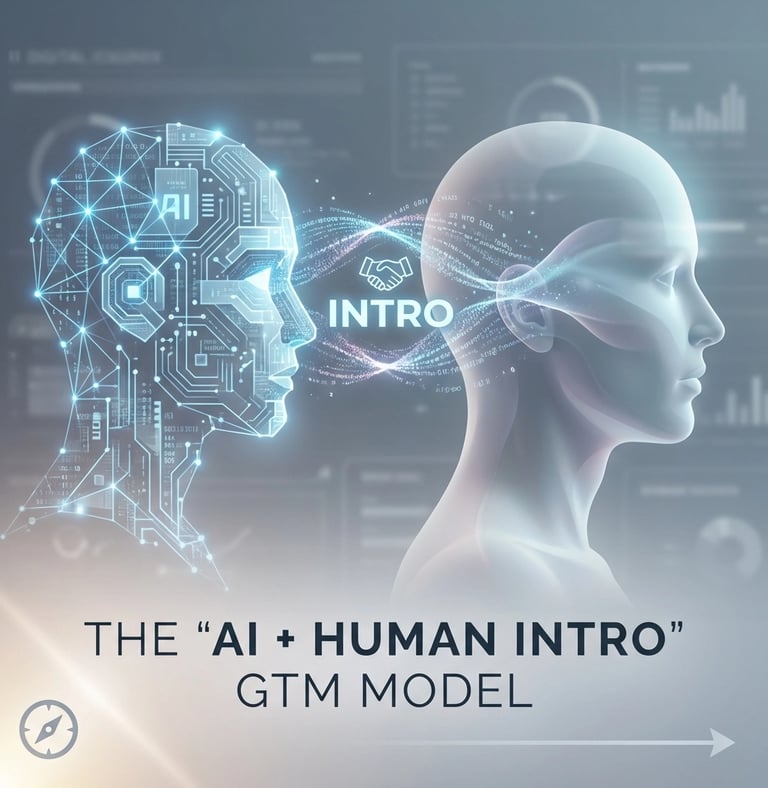
The "AI + Human Intro" GTM Model
I've watched hundreds of premium service providers chase the AI automation dream. They build elaborate sequences, deploy AI SDRs, and automate everything from prospecting to follow-ups. Then they wonder why their reply rates tank and their pipeline stays empty.
Here's what I've learned: AI is incredible at finding needles in haystacks. Humans are incredible at getting other humans to care. The magic happens when you stop trying to replace one with the other.
The Problem with Pure AI Outreach
When AI first launched into the GTM space, like many professionals, I thought we'd cracked the code. Finally: personalized outreach at scale without the manual grunt work.
But here's the catch: everyone else had the same idea. Now decision-makers get 47 "AI-researched" emails per day that all sound eerily similar. They've developed pattern recognition for automated outreach faster than we developed better AI.
Meanwhile, a warm introduction from a trusted mutual connection still gets read. Still gets replied to. Still gets meetings booked.
So let's dive into a model that actually works.
The AI + Human Intro Model Explained
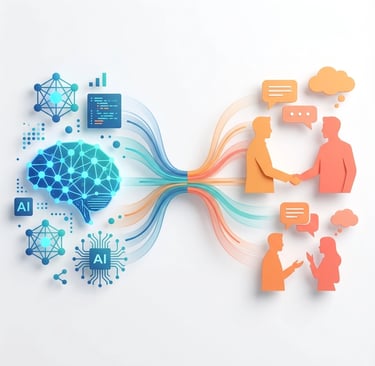
This isn't about choosing sides. It's about playing to each strength:
AI handles the heavy lifting:
Target identification and list building
Signal detection (hiring, funding, expansion)
Research and hypothesis generation
Message drafting and personalization
Data analysis and scoring
Humans handle the relationship layer:
Context and trust-building
Warm introductions through existing networks
Nuanced positioning and timing
Relationship nurturing and follow-through
The workflow looks like this: AI finds the right people at the right time with the right context, then humans leverage existing relationships to make the actual connection happen.

The Step-by-Step Workflow
Step 1: Define Your ICP + Trigger Events
Start by feeding your AI tools crystal-clear parameters. Not just demographics, but behavioral triggers that signal buying intent.
For a fractional CFO, this might be:
Series A companies 6-18 months post-funding
Recent leadership changes in finance roles
Job postings for "interim" or "part-time" finance positions
Companies that just hired their first 10 employees
Step 2: AI Target List + Hypotheses
Deploy AI to build your target list and generate hypotheses about each prospect's likely challenges. The key here is moving beyond basic firmographic data to situational intelligence.
Your AI should deliver:
Company name and decision-maker contact
Specific trigger event that caught attention
Hypothesis about their current challenge
Suggested positioning angle
Confidence score (how strong is this signal?)
Step 3: Create Intro-Ready Assets
Before you start asking for introductions, package your research into assets that make it easy for connectors to help you:
One-paragraph company overview showing you've done your homework
Specific hypothesis about how you can help
Clear ask (30-minute conversation, not "picking their brain")
Your credibility proof points relevant to their situation
Step 4: The Intro Sprint
Now comes the human magic. Map your target list against your network:
Who in your network knows this decision-maker directly?
Who knows someone who knows them (second-degree connections)?
What industry connections, advisors, or board members could make an introduction?
Reach out with context: "I've been researching companies going through [specific situation]. Based on my analysis, [Company] seems to be dealing with [specific challenge]. I think a 30-minute conversation with [Name] could be valuable for both of us. Would you be comfortable making an introduction?"
Step 5: Simple Scorecard
Track what matters:
Introduction requests sent
Introductions made
Meetings booked from intros
Opportunities created
Don't track vanity metrics like "AI messages sent" or "personalization tokens used." Track relationship-driven outcomes.
Weekly Cadence That Works
Monday: AI research sprint (2 hours)
Run your trigger event searches
Generate target list with hypotheses
Score and prioritize opportunities
Tuesday-Thursday: Network mapping (30 minutes daily)
5-7 introduction requests per day
Focus on highest-scoring targets first
Use your intro-ready assets to make asks simple
Friday: Follow-up and analysis (1 hour)
Follow up on pending introduction requests
Analyze what's working in your positioning
Refine your AI prompts based on results
This rhythm gives you 20-30 quality introduction requests per week instead of 200 cold outreach messages that get ignored.
5 Essential AI Prompts for This Model
1. Trigger Event Detection:
"Analyze [company website/news/LinkedIn] and identify signals that suggest they might need [your service] in the next 3-6 months. Focus on hiring patterns, funding announcements, leadership changes, expansion plans, or industry challenges."
2. Challenge Hypothesis:
"Based on [company info] and the trigger event [specific event], what are the 3 most likely operational challenges they're facing that a [your role] typically solves? Rank by confidence level."
3. Positioning Angle:
"Given [company challenge hypothesis] and my background in [your expertise], craft a positioning statement that shows specific relevance to their situation without being salesy."
4. Introduction Request:
"Write a 3-sentence introduction request to [connector name] asking them to introduce me to [target name] at [company]. Include context about why this could be valuable for both parties. Keep it under 75 words."
5. Research Summary:
"Summarize [company research] into a 2-paragraph overview that demonstrates I understand their business and situation, suitable for sharing with someone making an introduction."


What Not to Do (Critical Warnings)
Don't over-automate the relationship layer. AI can draft your introduction requests, but send them personally. Add your own context. Show up as a human.
Avoid fake personalization. "I saw you posted about your vacation in Cabo" when you clearly didn't see anything is worse than no personalization at all.
Don't ignore the ethics. If you're using AI to research someone's personal information for outreach purposes, ask yourself: would I be comfortable if someone did this to me?
Don't skip the value hypothesis. Having AI identify that someone "recently got promoted" isn't enough. Why should they care about talking to you about it?
Don't scale too fast. Better to send 5 thoughtful introduction requests than 50 generic ones. Quality relationships compound; spray-and-pray approaches don't.
The Results You Can Expect
When you nail this model, your meeting booking rates jump from the typical 1-3% (cold outreach) to 15-25% (warm introductions). More importantly, these meetings convert to opportunities at much higher rates because you're entering conversations with context and trust already established.
The compound effect is powerful: every introduction request you send also strengthens your relationship with the person making the introduction. You become known as someone who does their homework and makes specific, valuable requests.
But don't throw in the towel on your current approach just yet. Start small: pick 10 target companies this week and test the full workflow. You'll quickly see which parts of your current process were actually working and which were just busy work.
Ready to Build Your AI + Human Intro Engine?
The future of premium service sales isn't choosing between AI and human relationships: it's orchestrating them together. AI gives you superhuman research capabilities. Human relationships give you superhuman access.
At IntroFlows, we've built our entire model around this principle. We use AI and data to source real demand signals, then leverage our network to make warm introductions to decision-makers who are actively buying, hiring, or looking for solutions like yours.
Book a call to see how we can plug into your AI research workflow and turn your target list into warm conversations.