
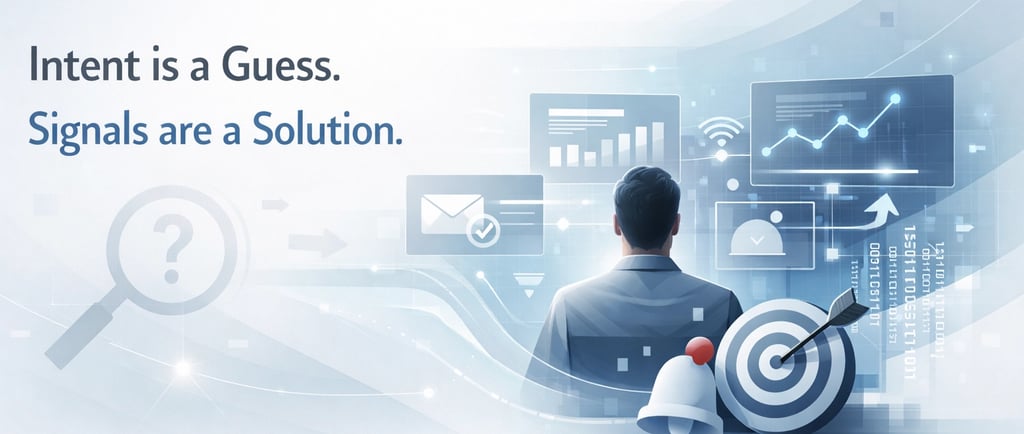
Intent Is a Guess. Signals Are a Solution

Everyone's obsessed with intent data right now. It's being sold as the holy grail of B2B sales, this magical layer of intelligence that tells you exactly when someone's ready to buy. The promise is simple: know what your prospects are researching, and you'll know when to reach out.
But here's what actually happens: you buy intent data, get a list of companies "showing interest," and then... you send them a cold email. With better timing, sure. But it's still cold. And it still feels like spam.
Because at the end of the day, intent is a guess. You're inferring interest based on anonymous web behavior, keyword searches, or content downloads. You don't know who is actually looking, why they're looking, or if they're even the person who can make a decision. You just know that someone at Company X downloaded a whitepaper about your category last Tuesday.
So you shoot your shot. And most of the time, it lands in the same place as every other "perfectly timed" cold email, ignored or deleted.
The Problem with Intent Data (It's All Inference)
Intent data providers track digital breadcrumbs. They monitor what content gets consumed, which topics are trending within certain accounts, and how often someone visits sites in your category. Then they package that behavior as "buying intent."
But think about what that actually means. If someone at a Fortune 500 company downloads a guide on "AI-Powered Workflow Automation," does that mean the company is ready to buy your software? Or does it mean:
An intern is doing research for a college project
A consultant is gathering competitive intelligence
Someone clicked the wrong link
An analyst is creating an internal report (with zero buying authority)
You don't know. All you have is a signal that someone, somewhere engaged with something adjacent to what you sell. That's not demand. That's a data point wrapped in assumption.
And when you act on it by sending a cold email, you're basically saying, "Hey, I noticed you might have been thinking about something vaguely related to what I do, so here's my pitch." It's spam with slightly better targeting.


What Signals Actually Are (And Why They Matter)
Signals are different. They're not inferences, they're facts.
A signal is a real-world event that indicates something concrete is happening inside a company. It's not someone anonymously browsing your competitor's website. It's:
A company closing a $50M Series B round
A VP of Sales getting hired at a private equity-backed portfolio company
A firm opening a new office in Dallas
An executive posting on LinkedIn about scaling their team
These are observable, verifiable moments that create actual buying windows. They're not guesses about what someone might be interested in, they're proof that a company is in motion, making changes, and likely needs help.
The difference is night and day. Intent data says, "Someone here might be curious." Signals say, "This company is actively doing something that creates a need."
But here's where most people get it wrong: they treat signals the same way they treat intent data. They plug signals into their cold email tool and blast away. "Congrats on the funding! Let me tell you why you need our solution."
That's not using signals. That's just cold outreach with a better hook.
The Real Value of Signals: They Open Doors for Warm Introductions
If you're in a business that depends on trust, staffing, wealth management, advisory services, PE deal sourcing, cold emails don't cut it. Nobody hires a recruiter because they got a great cold email. Nobody hands over their portfolio to a wealth advisor who sent a LinkedIn message with "synergy" in the subject line.
High-trust services require warm access. You need someone to vouch for you. You need an introduction.
And this is where signals become incredibly powerful: they tell you when to ask for that introduction.
Let's say you work with private equity firms and you notice that one of your target funds just made a new platform investment in the healthcare staffing space. That's a signal. It's real, it's public, and it means they're going to need operational support, back-office help, maybe recruiting.
Now, instead of sending a cold email to the Operating Partner (who gets 47 of those a day), you use that signal to reach out to someone in your network who knows them. You say, "Hey, I saw XYZ Fund just closed on a healthcare staffing platform. I know you worked with their ops team before: any chance you could introduce me? I think we could help with [specific value]."
That's the difference. The signal didn't trigger spam. It triggered a warm introduction with context, relevance, and trust baked in.


Intent Makes You Look Desperate. Signals Make You Look Informed.
When you reach out based on intent data, you're essentially saying, "I've been watching you." It's a little creepy, and it positions you as someone who's guessing and hoping.
When you reach out based on a signal: especially through a warm introduction: you're saying, "I noticed something meaningful is happening at your company, and I think I can help." You look informed, not invasive. You look like someone who understands their business, not someone who bought a list.
This matters especially in professional services. If you're trying to break into a PE fund, a family office, or a portfolio company, you can't afford to look like just another vendor blasting emails. You need to look like someone who belongs in the room.
Signals give you that credibility. Intent data doesn't.
How IntroFlows Turns Signals into Access
This is exactly why we built IntroFlows the way we did. We don't help you send better cold emails. We help you turn signals into warm introductions.
Here's how it works: we monitor the signals that matter for your business: funding announcements, executive moves, portfolio company activity, office expansions, whatever is relevant to your ideal buyer. When a signal fires, we don't send an email on your behalf. We identify who in your extended network can make a warm introduction to the right person at that company.
Then we facilitate the ask. We help you leverage your existing relationships (and ours) to get in front of the decision-maker with trust, context, and relevance already established.
For staffing agencies, that might mean getting introduced to the COO of a newly funded company who's about to scale headcount. For wealth advisors, it might mean getting introduced to an executive who just exited their company and is sitting on liquidity. For PE-focused service providers, it could mean getting introduced to a fund that just closed a new platform deal in your vertical.
The signal is the trigger. The introduction is the method. Access is the result.
We've written more about this approach in Why Staffing Agencies Are Ditching Intent Data for Direct Introductions and Referrals Don't Scale. Introductions Do.


Stop Guessing, Start Building Access
Look, intent data isn't useless. It has its place in certain types of marketing and lead scoring. But if you're relying on it to drive your outbound motion: especially in a high-trust, relationship-driven business: you're fighting an uphill battle.
You're guessing about interest, inferring intent from anonymous behavior, and hoping your cold email stands out in a sea of noise. Even when you're right about the timing, you're still a stranger asking for a meeting.
Signals are different. They're concrete, they're actionable, and when used correctly, they create opportunities for warm access instead of cold pitches.
The companies that win in 2026 won't be the ones with the best intent data. They'll be the ones who know how to turn real-world signals into real-world introductions: and who understand that access, not volume, is what actually drives revenue in professional services.
So the next time someone tries to sell you on intent data as the future of outbound, ask yourself: do you want to guess better, or do you want to stop guessing altogether?
Because signals don't make you a better cold emailer. They make cold email irrelevant.